

Main Narrative
The dollar had a strong growth number to work with. It still couldn’t hold its gains. Falling US yields, a bruising session for technology shares and the euro’s recovery after the ECB left CHF and GBP leading, with AUD firmly at the bottom.
US GDP grew 3.4% annualised, up from 2.2%, with stronger private domestic demand reinforcing the economy’s resilience. September offered a softer consumer picture: income rose just 0.2%, and spending was flat after inflation. Core PCE rose 0.3% monthly and 3.1% annually; headline inflation reached 3.6%. Households are feeling the squeeze, while inflation still gives the Fed work to do.
Markets nevertheless trimmed December tightening expectations to roughly 20 basis points from 21.5. That modest retreat helps explain the softer dollar. Expectations still favour further tightening.
The ECB delivered the expected 2.50% hold, initially sending EUR/USD towards 1.1105. Lagarde then confirmed that policymakers had discussed a hike and could justify one. The euro recovered towards 1.1168 later in US trading. Reuters subsequently reported that policymakers favoured a December increase followed by a pause—an expectation that remains conditional on the economic outlook.
Market Reaction
- Equities: the Nasdaq Composite lost about 1.4% and the S&P 500 0.3%, while the Russell 2000 gained around 1%. European shares also advanced. Alphabet’s disappointment hurt technology, but investors remained willing to own other parts of the market.
- After the bell: Amazon and Intel added pressure to futures. Amazon still reported AWS growth of roughly 39%, alongside substantial investment-driven cash outflows. Our read: strong demand alone is becoming insufficient; investors want convincing returns on the spending.
- Bonds and USD: Treasuries rallied, short-term yields fell and DXY slipped back below 102. Strong GDP failed to generate sustained additional rate support for the dollar.
- Commodities: December WTI settled at $102.00, down $0.78; January Brent at $110.80, down $0.84. Diplomatic headlines helped oil lower, but shipping incidents and conflicting Iran reports left supply risks unresolved. Gold and copper also weakened.
- Late Japan data: Tokyo core inflation eased to 2.6%, while inflation excluding fresh food and energy slowed to 2.4%. That complicates the tightening argument immediately before the BoJ decision.
Currency Strength
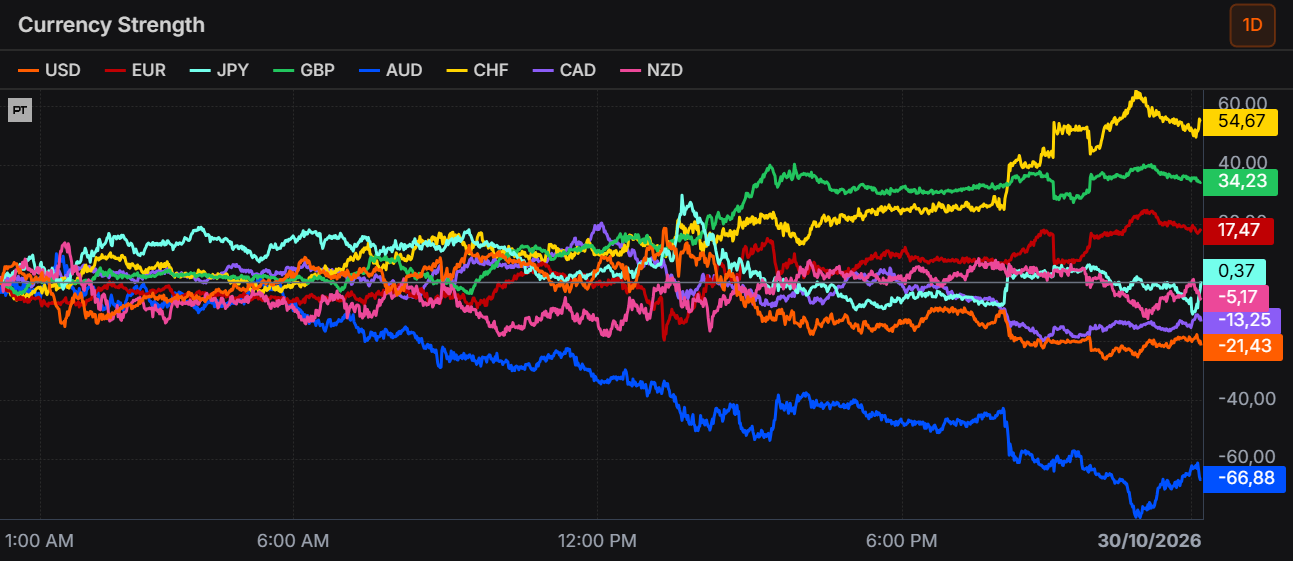
| Currency | Late-session assessment |
|---|---|
| CHF | Strongest, with gains accelerating late. The clearest defensive preference. |
| GBP | Sustained broad strength despite limited fresh domestic news. |
| EUR | Recovered from the ECB sell-off and retained a stronger finish. |
| JPY | Around flat overall after its earlier strength faded. |
| NZD | Weaker, although December-hike commentary provided a policy counterweight. |
| CAD | Lost its earlier leadership. Wednesday’s hike did not prevent Thursday’s retreat. |
| USD | The morning recovery failed as yields softened. |
| AUD | Weakest through much of the day; domestic inflation support was overwhelmed by broader selling. |
Lesson
A good economic number does not guarantee a stronger currency. The dollar needed investors to raise the expected US rate path. They edged it lower instead. Likewise, the unchanged ECB rate did not settle the euro’s direction—the explanation changed the reaction.
Forward Implication
- AUD/CHF: the clearest current weakness-versus-strength pairing. A bearish view depends on continued pressure on growth-sensitive assets and persistent CHF demand. Australian inflation still supports RBA tightening, so Thursday’s price move alone cannot settle the fundamental case.
- EUR/GBP versus EUR/CAD: sterling’s strength keeps the former more interesting for a conditional EUR-short view. CAD’s retreat and the ECB’s firmer message weaken the immediate EUR/CAD-short case. Broad euro selling now needs a stronger argument.
- USD/CAD: lower US yields help the bearish case, but CAD’s own weakness reduces its appeal. Relative Canadian rate support and Friday’s GDP matter. Selling dollars works best when the other currency has a reason to strengthen.
What Invalidates This Thesis
A sustained rise in US rate expectations would challenge the softer-dollar view. Stronger RBA tightening expectations, an AUD recovery and fading CHF demand would undermine AUD/CHF downside. EUR shorts become less attractive if European data strengthen the ECB outlook relative to the opposing central bank. CAD needs renewed oil and relative-rate support to restore its stronger-currency appeal.