

Main Narrative
NZD spent the day trying to recover from a hike that never arrived. CAD moved to the front as Canada delivered its increase, oil rose and the dollar weakened. AUD held second place, supported by hotter Australian inflation. Policy expectations did most of the sorting today.
The RBNZ held at 2.75%, against expectations for 3.00%. Its warning that further tightening would probably be needed could not repair the immediate disappointment. The BoC delivered its expected increase to 2.50% and left further hikes possible. CAD’s initial response was modest; its stronger finish developed later, alongside firmer oil and a weaker USD. RBNZ decision · BoC decision
The Fed held at 3.75–4.00%, with two members wanting a hike. Warsh emphasised that September’s increase was starting to work and kept December open. The dollar lost ground, but traders only slightly reduced expectations for the next hike. The Fed bought itself time; markets still expect more tightening. FOMC statement
Market Reaction
- Rates: US two-year yields eased to around 4.73%, while ten-year yields rose to 5.05% at settlement. Less urgency to hike did not translate into cheaper long-term borrowing. The dollar’s weakness therefore makes more sense alongside the short end of the curve than the rising ten-year yield.
- Equities: the Nasdaq 100 gained 0.55% and the S&P 500 0.28%, but the equal-weight S&P was flat. Oracle’s financing plans helped technology sentiment; participation remained uneven.
- After-hours earnings: Microsoft rose after beating expectations, while Alphabet fell after its misses despite strong cloud growth. My read: AI demand remains healthy, but earnings delivery and the cost of expansion are still being judged company by company.
- Oil and gold: December WTI settled at $102.78, up $2.88, and January Brent at $111.64, up $2.23. Diplomacy generated reversals without removing the supply risk. A late White House assurance against strikes before the US midterms narrowed the immediate window, without establishing a lasting agreement. Gold was broadly flat.
- UK Budget: the package avoided a major funding shock. Lower planned issuance of long-dated gilts offered support, but the growth/inflation mix remains uncomfortable: 1.0% growth and 3.4% inflation in 2027. Sterling’s later improvement does not resolve that problem. OBR inflation forecast
Currency Strength
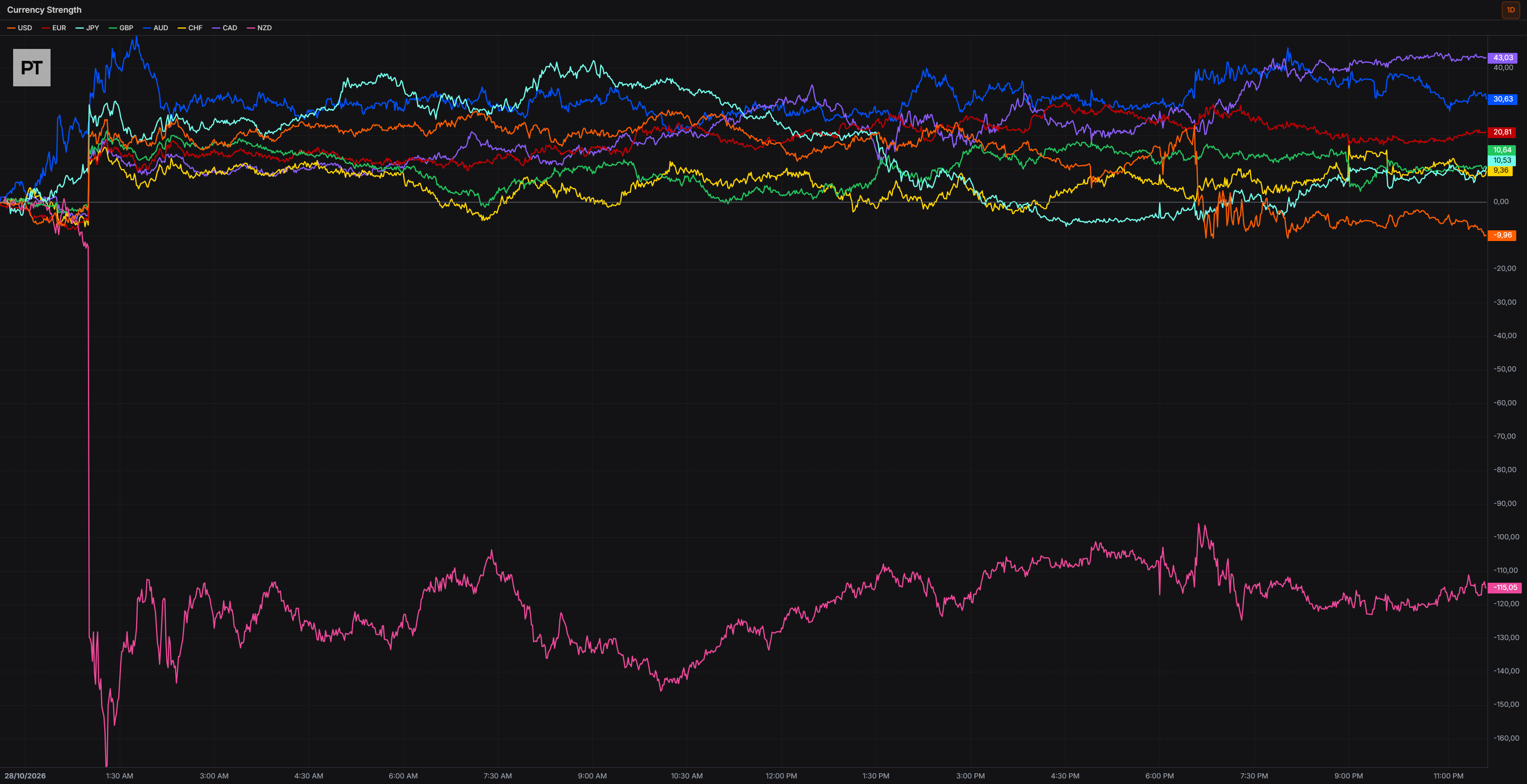
| Rank | Currency | My read |
|---|---|---|
| 1 | CAD | Strongest finish, with policy and oil support. Trade tensions remain the counterweight. |
| 2 | AUD | Inflation kept pressure on the RBA to tighten; strength held through the day. |
| 3 | EUR | Recovered, helped by USD weakness. Tomorrow’s ECB is the test of independent policy support. |
| 4 | GBP | Improved after the Budget and Fed; the weaker growth outlook still limits conviction. |
| 5 | JPY | Recovered from weaker levels, without establishing sustained leadership before the BoJ. |
| 6 | CHF | Modest relative strength, with little evidence of broad defensive leadership. |
| 7 | USD | Lost support during the Fed conference; tomorrow’s inflation data can challenge that move quickly. |
| 8 | NZD | A partial recovery left most of the overnight damage intact. |
Lesson
Hawkish words need to be weighed against what was already expected. NZD’s prospect of higher rates later did not replace the missing hike today. Two hawkish Fed dissenters did not deliver a commitment to December. The decision, guidance and market expectations have to be read together.
Forward Implication
I still favour CAD and AUD’s policy backing over NZD’s, while recognising how much the market has already moved. Continued strength now needs those relative policy expectations to hold.
EUR’s recovery faces the ECB tomorrow, and the softer-dollar view faces PCE inflation. GDP also needs a look beneath the headline: the wider US goods deficit could drag on growth even while imports support investment and inventories. A weaker headline alone would not establish collapsing domestic demand.
What Invalidates This Thesis
The CAD/AUD preference weakens if their expected rate paths fall relative to New Zealand’s. A sharp oil reversal would also challenge CAD, while worsening global growth would threaten AUD. Renewed US inflation pressure accompanied by higher relative US rate expectations would undermine the softer-dollar view.