

Main Narrative
The day developed into a technology-led equity recovery alongside a firmer dollar and lower oil. AI financing developments helped sentiment, while US data offered reassurance on demand. The underlying figures were mixed, however, and the Treasury move did not produce a fresh increase in Fed tightening expectations. AUD held the strongest finish, EUR remained weakest, and NZD surrendered a substantial part of its earlier lead.
US consumer confidence rose to 91.7, comfortably above expectations near 81 and September's revised 84.2. Expectations improved but remained subdued at 72.6. Durable-goods orders increased 1.8% versus 1.5% expected, with transportation driving most of the rise; orders excluding transport increased 0.5% versus 0.6% expected, while core capital-goods orders rose 0.5% versus 0.7% expected. New-home sales beat expectations at 676,000, but were still 0.6% below the revised August pace. The message was resilience with uneven underlying momentum.
Europe's constraints remained visible: tighter bank lending standards, weak French confidence and fiscal uncertainty continued to weigh on the euro's outlook. Most European equity markets nevertheless recovered by the close. Earlier weakness in equities and gold did not describe the whole day.
Market Reaction
Equities: Nasdaq 100 +1.29%, S&P 500 +0.60% and Russell 2000 +1.16%; the Dow was almost flat. Technology and consumer discretionary led, while energy fell 2.20%. Euro Stoxx 50 gained 0.79%, but the FTSE lost 0.75%.
Rates and USD: the US two-year yield rose 1.7bp to 4.737%, the ten-year edged up 0.3bp to 4.991%, and the thirty-year slipped 0.2bp. The curve flattened mildly. October Fed hike pricing edged lower and December pricing was broadly unchanged, so firmer short-term yields were not evidence of a new hawkish policy repricing. DXY was around 102.35 in the late snapshot.
Oil: earlier gains reversed. December WTI settled at $99.90, down $1.86; January Brent at $109.41, down $1.33. Diplomatic possibilities remained in play, but conflicting Iran/Hormuz claims and late Saudi warnings left escalation risk unresolved. Neither an implemented peace agreement nor the extent of lasting infrastructure damage was established.
Gold: recovered above $4,000, gaining around 1.1% in the late snapshot despite the firmer dollar. The day's cross-asset response did not fit a simple all-clear risk rally.
After settlement: private inventories showed a roughly 2-million-barrel crude draw alongside gasoline and distillate builds. This was a mixed update arriving after oil's settlement, with the official figures still ahead.
Currency Strength
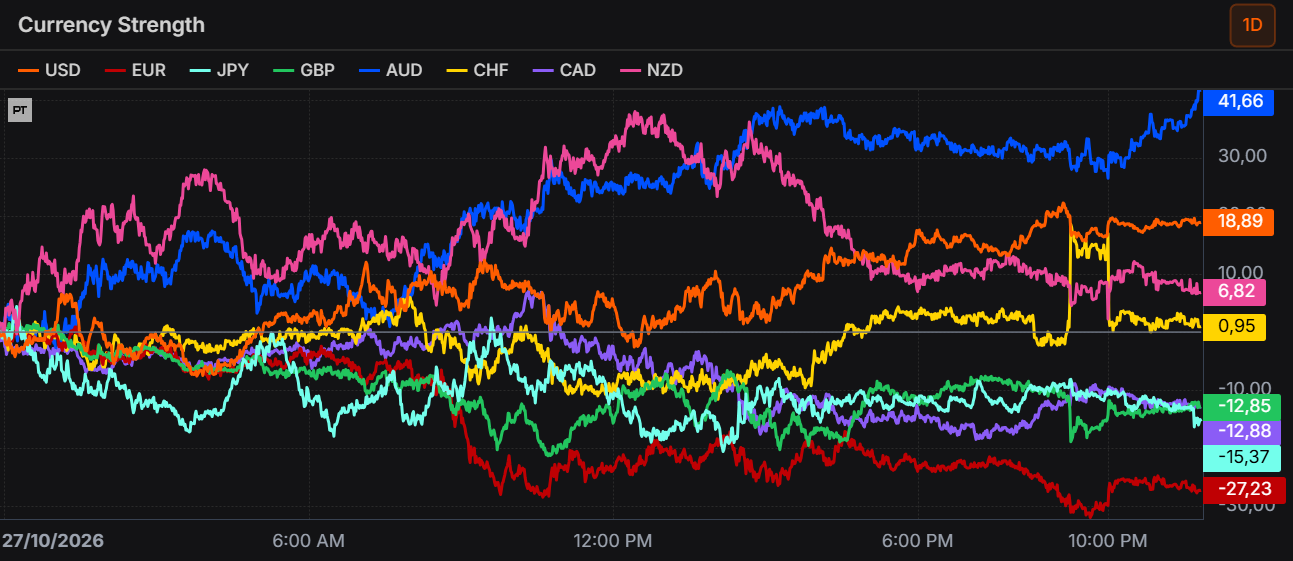
| Rank | Currency | Assessment |
|---|---|---|
| 1 | AUD | Clearest leader; retained much of its advance ahead of CPI. |
| 2 | USD | Recovered through the US session; the earlier bearish tilt remains suspended. |
| 3 | NZD | Strong over the whole day, but gave back a substantial portion of its earlier gains. |
| 4 | GBP | Recovered from weaker levels but remained negative ahead of the Budget. |
| 5 | CAD | Weakened later; lower oil added a headwind before the BoC. |
| 6 | JPY | Remained weak overall; sustained confirmation of the tactical bullish case is still missing. |
| 7 | CHF | Its late rebound did not establish persistent defensive leadership. |
| 8 | EUR | Broad weakness persisted into the late snapshot. |
Forward Implication
EUR remains a credible weak leg, while AUD has the strongest current confirmation. That does not automatically upgrade AUD's weekly fundamental bias before CPI. CAD's positive weekly case has weaker daily confirmation, and JPY's tactical bullish case remains conditional.