
Canada’s October inflation report falls short of headline forecasts, while the underlying measures send a mixed signal. CPI-trim is below expectations and CPI-median is in line, but the separate monthly core reading is stronger. The release does not deliver the broad upside surprise that would give the Bank of Canada a clearer reason to tighten further.
The headline is softer than expected
Consumer prices rise 0.2% in October, against a 0.4% forecast and 0.1% in September. Annual inflation holds at 3.1%, below the 3.2% expected. This is a forecast miss, rather than a decline in the annual inflation rate; monthly price growth also remains positive.
| October measure | Actual | Expected |
|---|---|---|
| Headline CPI, monthly | 0.2% | 0.4% |
| Headline CPI, annual | 3.1% | 3.2% |
| CPI-trim, annual | 1.8% | 1.9% |
| CPI-median, annual | 2.0% | 2.0% |
| Core CPI, monthly¹ | 0.4% | 0.2% |
¹ The separately reported core CPI series is distinct from CPI-trim and CPI-median.
The core measures do not all tell the same story
The Bank of Canada’s preferred core measures, CPI-trim and CPI-median, do not produce a broad upside surprise. Trim is below forecast at 1.8%, while median matches expectations at 2.0%. That weakens the argument for treating this release as fresh evidence of widespread inflation acceleration.
There are counterweights. The separate monthly core figure rises 0.4%, twice the forecast, while CPI-common increases to 2.5% from 2.4%. The separate annual core rate eases to 2.0% from 2.2%. A stronger monthly reading can coexist with a lower annual rate because the comparison periods differ. Those results argue against declaring uniform underlying cooling from the headline miss alone.
What this means for CAD
Ahead of the release, the question was whether persistent underlying pressure would give Canadian rates, and therefore CAD, stronger domestic support. The trim and median results do not provide that clear confirmation. Equally, the stronger separate monthly core reading means this is not an unambiguous signal for a softer BoC path.
My focus is now on the policy response and relative rate expectations. A material reduction in expected Canadian tightening would weaken CAD’s rate support. If the BoC remains concerned about persistent pressure and Canadian rate expectations hold up, the initial negative currency response may prove less informative. Oil and foreign policy expectations remain separate influences; the CPI headlines alone do not establish how either has changed.
The immediate reaction
USD/CAD jumps from around 1.4286 to 1.4305, then pulls back towards 1.4294 in the supplied first-three-minute snapshot. That is an initial reaction only. The weaker US Empire State survey arrives simultaneously, so the pair’s move is not a clean measure of the Canadian release alone.
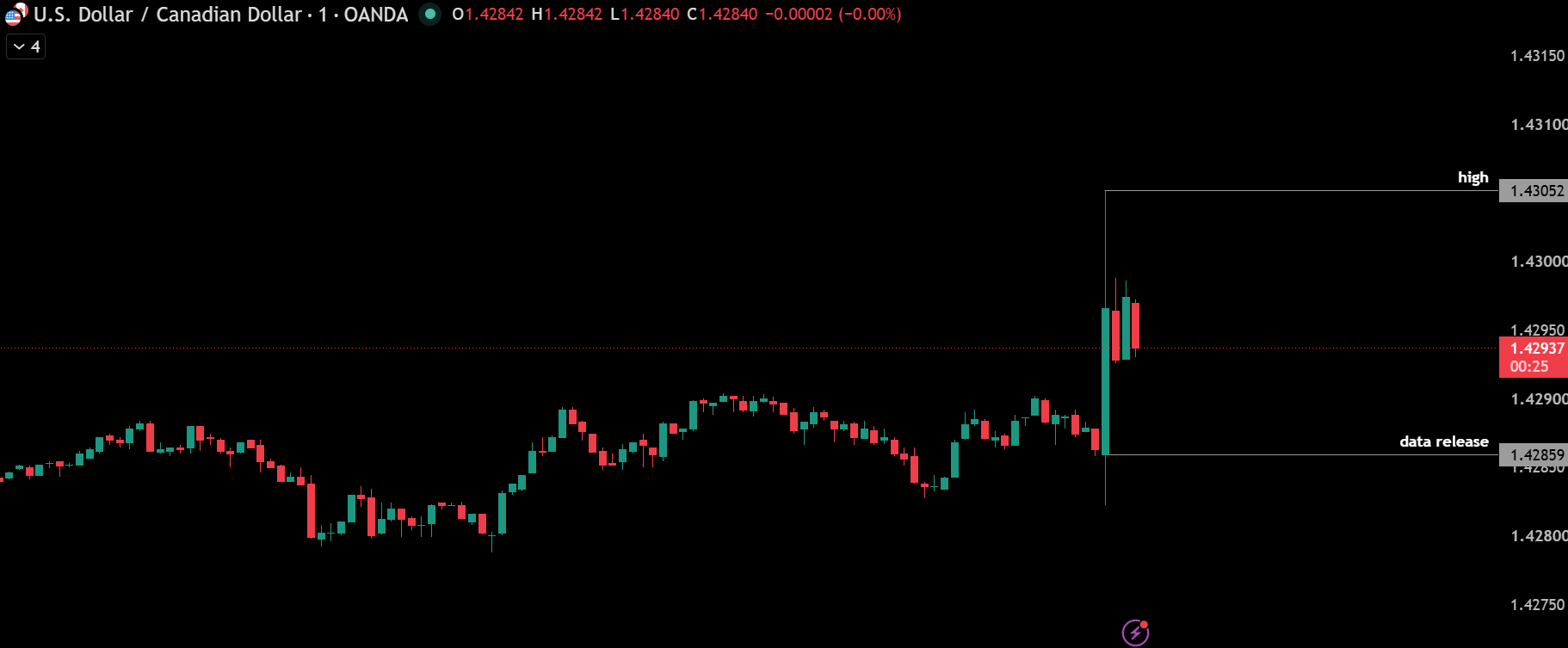
Source: TradingView / OANDA · 16 November 2026, 13:33 UTC
What would change this reading
Broader, persistent core pressure accompanied by a stronger expected BoC path and sustained CAD demand would improve the Canadian support case. Conversely, weaker underlying inflation and demand, alongside lower expected Canadian rates, would make the softer-policy interpretation more convincing. Neither conclusion follows from three minutes of price action.
The next tests · UTC
| Date | Time | Event | What I am watching |
|---|---|---|---|
| Mon 16 Nov | 17:00¹ | Fed Chair Warsh | Any new guidance affecting the dollar’s policy advantage |
| Tue 17 Nov | 13:30 | US retail sales | Whether consumer demand sustains expectations for further Fed tightening |
| Wed 18 Nov | 17:30² | BoC Gravelle, speech text | The policy interpretation after the mixed inflation report |
| Fri 20 Nov | 13:30 | Canadian retail sales | Spending volumes, breadth and revisions |
¹ Opening remarks; Warsh also moderates later sessions.
² Prepared text is released at 17:30; speech delivery and audience questions begin at approximately 17:45.